What to Watch for Between Your Dog's Grooming Appointments
Many dog owners treat grooming as a series of salon visits rather than a continuous part of their dog's care routine. The booking goes in the diary, the dog comes home looking and smelling clean, and the next slot gets scheduled four to six weeks later. What happens in between tends to get less attention, and that gap is where most grooming-related problems actually begin.
Professional groomers see this pattern constantly. A dog arrives at a grooming appointment with matting that has been tightening for weeks, nails that have curled past the point of a simple trim, or a skin condition that has been quietly developing since the last visit. None of these issues appeared overnight. They built up gradually during the weeks between appointments, in the space where nobody was looking closely enough.
Understanding what to monitor between dog grooming appointments, and why it matters for your dog's health and comfort, makes every visit to the groomer easier, faster, and more effective for everyone involved.
Why the Gap Between Grooming Appointments Deserves More Attention
A professional grooming appointment addresses coat, nails, ears, skin, and overall presentation in one focused session. But a groomer sees your dog for one to three hours every four to six weeks. That leaves a significant amount of time where the dog's condition is entirely in the owner's hands.
The breeds that need the most attention between appointments are not always the ones owners expect. Long-coated and curly-coated breeds like Poodles, Doodles, Shih Tzus, and Bichon Frises develop coat issues rapidly without regular at-home maintenance. But even short-coated breeds benefit from consistent checks in between professional visits. Skin conditions, ear problems, and nail growth do not discriminate by coat length.
The good news is that between-appointment care does not need to be complicated or time-consuming. It needs to be consistent.
Coat and Skin Changes That Develop Between Appointments
Matting Starts Small and Gets Worse Quickly
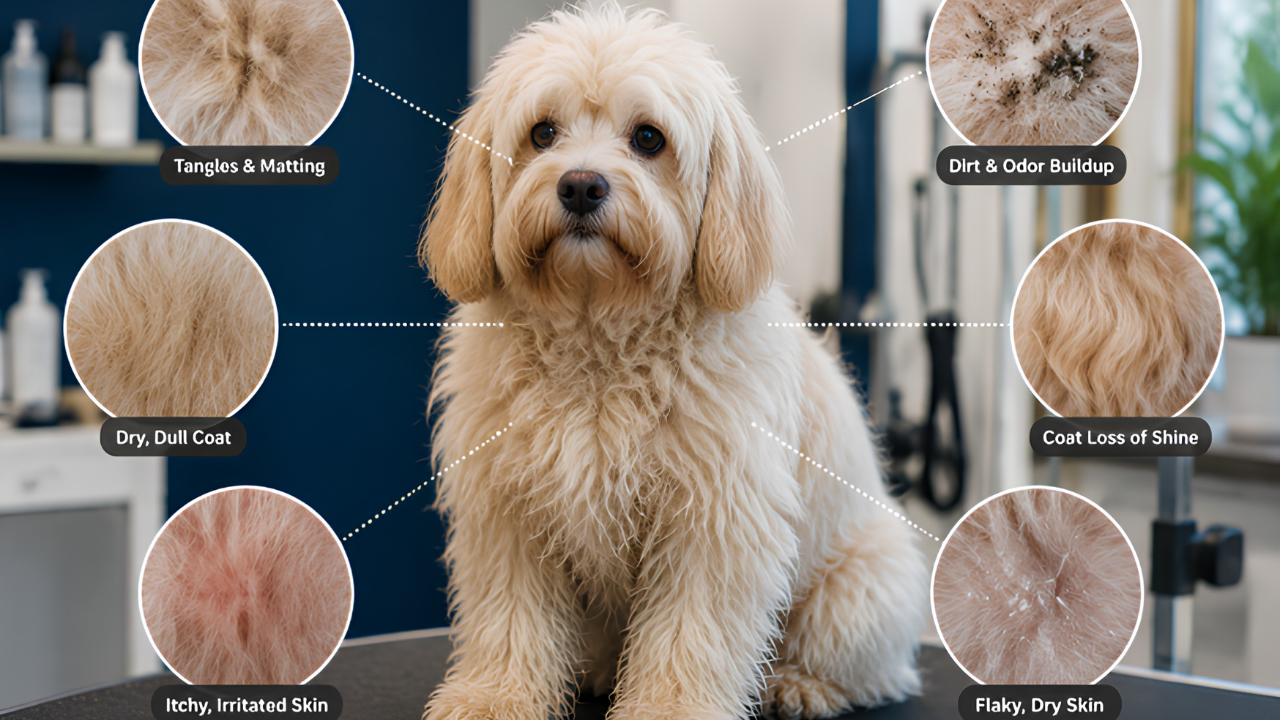
Matting rarely appears as a dramatic overnight event. It starts as a small tangle behind the ear, under a collar, or in the armpit area, and it tightens gradually over days and weeks. Once a mat reaches the point where an owner notices it, the dog has typically been uncomfortable for some time already.
Owners who brush their dog two to three times per week catch mats at the early, easy-to-remove stage. Owners who skip brushing for two or three weeks often find the same mat has become dense, tight, and close to the skin. At that point, removal requires a professional groomer and can be genuinely uncomfortable for the dog regardless of how carefully it is done.
The coat areas most prone to matting between grooming appointments are behind the ears, around the collar line, under the front legs, around the groin, and at the base of the tail. Running fingers through these areas during a weekly check takes under two minutes and catches problems before they compound.
Skin Conditions That Appear Between Visits
Dry patches, redness, hot spots, and unusual flakiness all tend to develop gradually and go unnoticed until they have progressed significantly. A groomer performing a thorough dog grooming appointment will check the skin carefully and flag anything concerning, but a lot can change in the weeks between visits.
Regular handling at home, especially when combined with brushing, gives owners the opportunity to notice skin changes early. A new red patch noticed on a Tuesday is manageable. The same patch left unattended for three more weeks before the next grooming appointment may require veterinary attention by then.
Nail and Paw Care Between Grooming Appointments
Why Nails Need More Attention Than Most Owners Give Them
Nail growth varies considerably between dogs depending on breed, age, diet, and how much time the dog spends on hard surfaces. A dog that walks daily on pavements and concrete wears nails down naturally and may need fewer nail trims than a dog that walks primarily on grass or soft ground.
The practical indicator most owners can use is sound. When a dog's nails start clicking consistently on hard floors, they have typically grown past the point where they are comfortable during movement. Left longer, nails begin to push the toes sideways, which affects posture and gait over time and creates discomfort that builds gradually and silently.
Professional groomers address nails at every dog grooming appointment, but some dogs, particularly those with fast-growing nails or low activity levels on hard surfaces, need more frequent attention between sessions. Learning to check nail length weekly is a simple habit that prevents a common and entirely avoidable discomfort.
Paw Pad Checks
Paw pads take daily wear and rarely get the attention they deserve between grooming appointments. Cracked pads, small cuts, debris lodged between the toes, and early signs of interdigital cysts are all easier to address when caught early through regular checking.
A brief paw inspection after walks, especially in summer when hot pavements can cause pad damage, or in winter when ice and road salt create their own problems, takes under a minute and builds the kind of handling tolerance that makes professional grooming appointments significantly easier as the dog matures.
Weight and Body Condition Changes
Gradual weight change is one of the most common things owners miss in their own dogs, simply because they see the dog every day and the change happens too slowly to register visually. At a professional dog grooming appointment, a groomer handles the dog thoroughly and sometimes notices body condition changes that have gone undetected at home. But groomers are not vets, and the responsibility for monitoring weight and body condition sits with the owner between appointments.
Running hands along the ribcage weekly is the simplest practical check. Ribs that are easy to feel beneath a thin layer of fat indicate a healthy weight. Ribs that are difficult to feel suggest weight gain, while sharply prominent ribs suggest underweight. Neither extreme should wait until the next dog grooming appointment to be addressed.
Behavioural and Mobility Clues Worth Noticing
Dogs do not communicate discomfort the way people do and are remarkably good at masking pain until it becomes significant. Small behavioural changes, a slightly shorter stride, more hesitation before jumping, reduced enthusiasm for activities they usually enjoy, or increased scratching at a specific area, often signal something worth investigating well before it becomes obvious.
Between dog grooming appointments, a brief weekly check covering coat condition, skin, ears, nails, paws, and general mobility builds a picture of what normal looks like for that specific dog. Any deviation from that baseline becomes much easier to spot against a consistent reference point. For owners who also maintain a regular dog walking routine, that daily handling time creates even more opportunity to notice small changes before they develop into something that requires professional attention.
What Good Between-Appointment Care Actually Looks Like
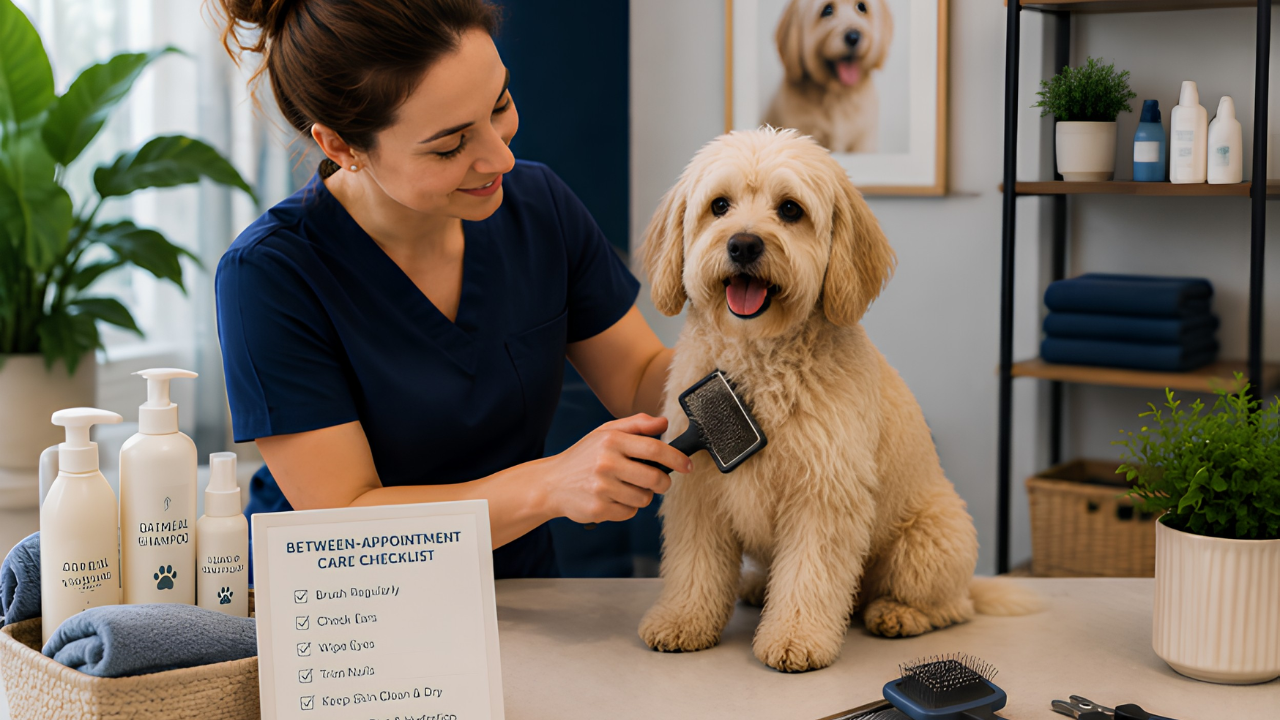
Effective at-home maintenance between professional dog grooming appointments does not require a full grooming setup or extensive equipment. It requires consistency and a basic routine that covers the key areas.
A practical weekly routine for most dogs includes:
- A thorough brush-through covering the entire coat, paying particular attention to mat-prone areas
- A quick nail length check against the floor sound test or visual inspection
- A paw pad inspection, especially after walks on hard or treated surfaces
- An ear check for unusual odour, redness, or discharge
- A skin scan during brushing for dry patches, redness, or unusual bumps
- A general handling session that keeps the dog comfortable with being touched across all body areas
This kind of consistent handling between appointments does something that professional grooming alone cannot: it keeps a dog comfortable with being touched everywhere. Dogs that receive regular handling at home arrive at their dog grooming appointment in a calmer, more cooperative state, which directly improves the quality of the groom and reduces stress for both the dog and the groomer.
How Groomers Use Between-Appointment Information
Professional groomers rely on owner observations between appointments to do their job more effectively. An owner who mentions that their dog has been scratching at the left ear for the past two weeks gives the groomer specific information to investigate. An owner who flags that brushing has been difficult in a particular area helps the groomer approach the coat more carefully in that spot.
This communication is part of what makes the groomer-owner relationship valuable beyond the groom itself. The signs of a bad groomer include dismissing owner observations or failing to communicate findings back after an appointment. A professional groomer treats the owner as a partner in the dog's ongoing care, not just a client dropping off a booking.
Groomers who understand canine behaviour and health, alongside their technical grooming skills, make the most of the information owners bring to each appointment. This is why professional grooming education covers far more than scissor technique. Understanding why basic dog training matters for professional grooming and how dogs communicate discomfort is foundational knowledge for any groomer who wants to provide genuinely thorough care.
How Frequently Should Dog Grooming Appointments Be Scheduled?
The right grooming frequency depends on breed, coat type, lifestyle, and how consistently the owner maintains the coat between professional visits. General guidelines by coat type are:
- Curly and wool-coated breeds (Poodles, Doodles, Bichon Frises): Every four to six weeks. These coats do not shed and mat rapidly without regular professional attention.
- Long-coated breeds (Shih Tzus, Maltese, Yorkshire Terriers): Every six to eight weeks, with thorough brushing several times per week between appointments.
- Double-coated breeds (Golden Retrievers, Border Collies, Huskies): Every eight to twelve weeks for professional grooming, with regular at-home de-shedding between visits.
- Short-coated breeds (Beagles, Boxers, Dalmatians): Every eight to twelve weeks for baths, nail trims, and ear checks, even if coat trimming is minimal.
Extending appointments beyond these windows without maintaining the coat at home is one of the most common reasons dogs arrive in poor condition and require significantly longer, more uncomfortable sessions to restore.
The Groomer's Role in Educating Owners Between Appointments
One of the most undervalued aspects of professional grooming is owner education. A groomer who explains what they found during an appointment, what the owner should watch for before the next visit, and how to maintain specific areas at home provides genuine value beyond the groom itself. This communication builds trust, improves dog welfare, and creates long-term client relationships that sustain a grooming business far more reliably than new bookings alone.
The signs of a bad groomer include dismissing owner observations or failing to communicate findings after an appointment. A professional groomer treats the owner as a partner in the dog's ongoing care.
Groomers trained through programmes covering client communication, canine health awareness, and coat science alongside technical skills are better equipped to provide this level of care. The Professional Dog Grooming Academy trains groomers to understand the full picture of a dog's ongoing care needs. The advanced dog grooming course and Groomer Assistant Course both cover coat health, skin assessment, and owner communication as core components of professional grooming education.
Final Thoughts
A dog grooming appointment is one part of a dog's ongoing care, not the whole of it. The weeks between appointments matter just as much as the appointment itself, and what happens during those weeks directly affects what the groomer finds on the day.
Owners who maintain a simple, consistent routine between visits give their groomers the best possible starting point. Groomers who educate their clients on between-appointment care create better outcomes for the dogs they work with and stronger relationships with the owners who trust them. Both sides of that equation matter, and both are worth investing in.